Timothy HydeEconomics · Oberlin College
Curriculum vitae Google Scholar ORCID thyde@oberlin.edu Department of Economics
Oberlin College, Oberlin, Ohio

Research

Working papers

2026Hershel Kasper Working Paper No. 6Under review

Information versus attention in flood risk disclosure

with Dolores Albarracín

Abstract

Flood risk disclosure is expanding rapidly in real estate markets, but if disclosures move demand by commanding attention rather than by conveying information, their welfare effects are ambiguous. We examine this tension in a discrete choice experiment where 1,498 respondents make hypothetical choices among real Gulf Coast properties under a control condition and four disclosure formats varying in informational content and presentation. Absent disclosure, insurance costs barely influence choices; by contrast, when respondents are shown precise flood insurance estimates, they are willing to pay $3.34 in annualized housing costs to avoid each annual premium dollar. Using a separate beliefs elicitation, we estimate each format’s technical information content and construct a Bayesian benchmark for how much choices should respond. Observed responses exceed this benchmark by a factor of four to six; informational content accounts for at most 30 percent of the response to any format.

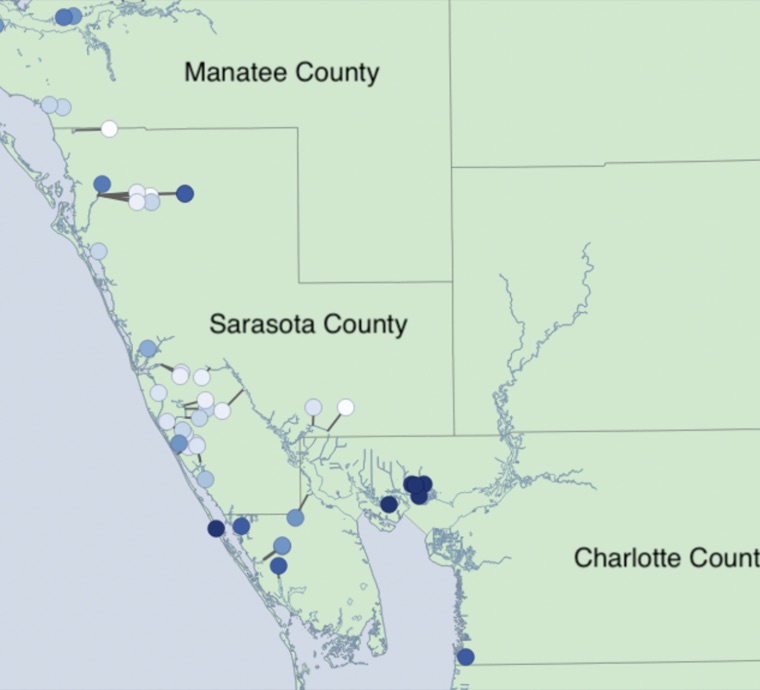
Map of Manatee, Sarasota and Charlotte counties on the Florida Gulf Coast, with the sampled properties marked and shaded by flood risk.
Gulf Coast properties used in the choice experiment
2026Working paperIn progress

Neglect at your own risk? Evidence on risk-taking prevalence and motives from the field

with Saurabh Bhargava

Abstract

We study risky choice in a large field setting where employees choose among goal-reward contracts resembling financial lotteries and where we observe both choices and beliefs. We find risk aversion and choice heterogeneity far exceeding expected utility predictions and unexplained by prominent behavioral motives like overconfidence, nonlinear decision weights, and loss aversion. We propose and experimentally validate a heuristic explanation for risk taking involving contingency neglect during pairwise evaluation. The heuristic fits the field and lab data better than competing models and offers a potential explanation for insurance puzzles involving under-insurance and excess heterogeneity.

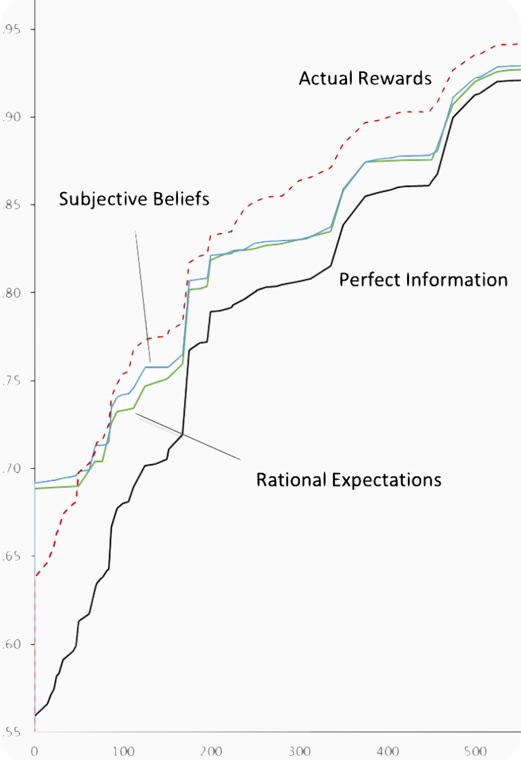
Cumulative distributions of rewards under actual goal choices, subjective beliefs, rational expectations and perfect information; actual rewards fall well below the perfect-information benchmark.
Rewards earned against belief and information benchmarks

Peer-reviewed publications

2026Journal of Risk and Uncertainty

How do risk perceptions change with new information? Evidence from a survey of flood-prone counties

with Caroline Hopkins

Abstract

Prior research has documented a tendency for insurance demand to rise abruptly in the aftermath of natural disasters. This may be attributable in part to the information shock that a disaster represents. Understanding how beliefs about risk evolve is of first-order importance for projecting climate adaptation in coming decades. Using a three-wave survey of 815 residents of flood-prone coastal counties in the southeastern United States, including 436 for whom we have longitudinal data, we study how individuals’ beliefs evolve after two very different types of informational shocks about future local flooding risk: viewing flood maps, and experiencing a local flooding disaster. We find that, on average, exposure to maps causes respondents to update their beliefs of their homes’ ten-year flood risk downward substantially (38%, 95% CI 13%-56%) and reduces their reported level of worry on a ten-point scale. We then leverage the natural experiment created by differential flood exposure during the hurricane seasons of 2017 and 2018, the latter of which fell between the initial wave of our survey and two follow-up waves. We find that flood disasters systematically increase flood concern in affected counties, as expected. More surprisingly, we find that those who experienced a flood before Wave 1 saw greater increases in concern between waves than those who did not – a pattern inconsistent with standard Bayesian updating and more consistent with the conservatism hypothesis, whereby experiential information shocks are incorporated into beliefs only gradually. This delayed updating process has implications for projections of climate adaptation among flood-prone populations.

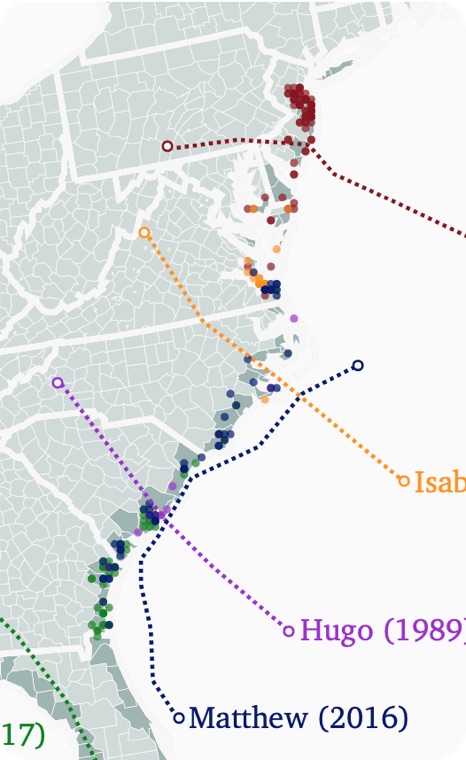
Map of southeastern coastal counties overlaid with the tracks of hurricanes including Hugo (1989), Matthew (2016) and Isabel, against the surveyed county sample.
Storm tracks across the surveyed coastal counties
2023Nature: Scientific Reports

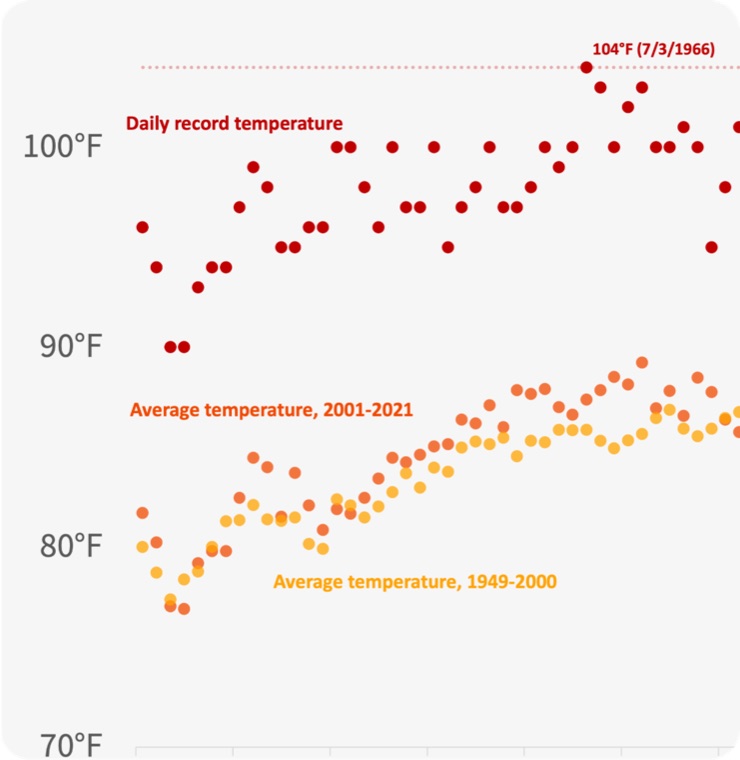
Record-breaking heat days disproportionately influence heat perceptions

with Dolores Albarracín

Abstract

From heat waves to hurricanes, tangible weather experiences strengthen personal belief in climate change. We ask whether a high temperature day that breaks local heat records — a mathematical construct not directly accessible to the senses — has additional impacts on perceptions of worsening heat, beyond the absolute temperatures themselves. Matching historical heat records to survey data from the United States, we find that each record heat day in a county in 2022 increases perceptions that excessive heat is getting worse, controlling for average temperatures, the number of extreme heat days, and demographics. Exposure to sixteen record heat days predicts roughly the same difference in heat perceptions as that between the average Democratic respondent and a political independent.

Scatterplot of daily record temperatures in red against average temperatures for 1949 to 2000 and 2001 to 2021 in orange and yellow, with the all-time record of 104 degrees marked.
Record highs against mid- and late-century averages

Works in progress

Flood me once, shame on you? Distant disaster experience and subsequent demand for coastal housing in Florida

The value of a statistical life and demand for others’ survival at the height of the Covid-19 pandemic in the United States

with Nicholas Z. Muller

Bayesian conspiracy theorists? Equivocal signals and persistent polarization

with Javier A. Granados Samayoa

Pricing the “Heat Katrina”: How do Arizonans perceive risk of power grid failure?

with Mikhail Chester

Behavioral erosion of private knowledge in insurance risk

with Saurabh Bhargava

Regulating the insurance menu: Coverage caps, underinsurance, and uncovered flood losses

with Shana Cui